

Maybe you own a piece of land in West Virginia and can picture the modular home you want to build there. Or maybe you are still searching for the right property and trying to figure out what is actually possible.
Either way, things can quickly turn an exciting project into a confusing one. Between zoning, permits, setbacks, site preparation, foundations, utilities, and rules for modular homes, it can be difficult to know where to begin.
The good news is that you do not need to become an expert in West Virginia building regulations before you can start planning your home. You simply need a clear path forward.
In this guide, Zook Cabins will help you understand the regulations and decisions that can affect your modular home project, from understanding local requirements to choosing a home that works with your site.
Our team has been working in the housing world for over two decades and we are prepared to clarify the way forward, starting off with specific county regulations in West Virginia for modular homes.
What are Modular Homes and Are They Allowed in West Virginia?
Yes! Modular homes are legal in West Virginia, and state law gives them important protection against being treated differently simply because they are factory-built. West Virginia defines a modular home as housing built in a factory that meets the state or local building codes applicable where the home will be placed.
Modular homes are built to the same applicable residential building codes, but much of the construction takes place indoors, where materials are protected from weather and the building process can be more consistent and efficient. Modular homes can also be customized with different floor plans, finishes, porches, rooflines, and other features, so they do not have to look or feel like a “factory-built” home. Once installed on an approved permanent foundation, they function much like any other conventional single-family home, while often providing a faster, more predictable path from design to move-in.
Zook Cabins’ job as your modular home builder is to help you understand requirements early enough that the home you choose works with the property you intend to build on.
Modular Home Requirements by County in West Virginia
Does Barbour County, West Virginia Allow Modular Homes?
Yes. For property outside Philippi, Belington, and Junior, Barbour County requires a Development Permit before you begin construction or site development. The residential application fee is $75. If the property is determined to be in a Special Flood Hazard Area, additional residential fees start at $25 for projects up to $30,000 and $2 per $1,000 of project cost above $30,000.
Even when county zoning does not dictate a specific building setback, your septic system can significantly affect where the home will fit. West Virginia requires every part of an individual sewage system to remain at least 10 feet from a building, foundation, or property line, and a septic tank must be at least 50 feet from a private well.
Before choosing the exact home and foundation location, start with the Barbour County Emergency Management office at 111 Overlook Drive in Philippi to get the $75 development permit and confirm the property’s flood status.
From there, confirm septic and well locations before finalizing the home footprint so Zook Cabins can help you choose a modular home that actually fits the usable building area of your property.
Does Berkeley County, West Virginia Allow Modular Homes?
It does but Berkeley County deserves more site planning than many rural West Virginia counties. Most of the county is not zoned, although the Tuscarora and Windewald districts have their own zoning regulations. Berkeley also requires a site plan whenever a project will disturb more than 5,000 square feet, and that plan must be approved before earth-moving or construction begins.
For residential lots subject to the county’s Subdivision and Land Development Ordinance, the standard minimum setbacks are 20 feet in front, 10 feet on each side, and 20 feet in the rear. Property adjoining I-81 has a much larger 100-foot setback from the edge of the highway right-of-way.
Water and septic can change the amount of land you need as well. Under Berkeley’s subdivision standards, a single-family lot using both an individual well and individual septic system generally needs at least 60,000 square feet of land and 125 feet of lot width; with public water and sewer, the minimum drops to 7,500 square feet and 75 feet of width. A new single-family residential building permit is currently $59 plus $0.24 per square foot.
Before selecting the final home or clearing the site, contact the Berkeley County Planning Department at 304-264-1963 to identify the property’s zoning status, subdivision requirements, floodplain status, driveway access, and utility arrangement. Once you know that usable building envelope, Zook Cabins can help you match the home and foundation plan to it.
Does Boone County, West Virginia Allow Modular Homes?
Yes. Boone County’s permitting process focuses heavily on development and floodplain review rather than a detailed countywide residential zoning schedule. The county requires a development permit before beginning development, and its published residential fees are $50 for a stick-built home, $35 for a manufactured doublewide, and $25 for a manufactured singlewide. If the property is in a flood zone, Boone County says an elevation certificate will likely be required to determine how high the home must be placed above the property’s Base Flood Elevation.
Start with the Boone County Emergency Management and Permit Office at 1267 Smoot Avenue in Danville or 304-369-7273 before grading the property; the office can review the flood map, issue the development permit, and provide the new address verification as part of the permit process.
Does Braxton County, West Virginia Allow Modular Homes?
Braxton County is relatively flexible for a homeowner building on unincorporated land. The state’s planning inventory identifies a county comprehensive plan but no countywide zoning or subdivision ordinance, while Braxton County’s current ordinance list specifically includes its Floodplain Ordinance and Enhanced 911 ordinances. In practical terms, that means you generally are not working from one countywide table requiring, for example, a 25-foot front yard and 10-foot side yards. Instead, you need to determine things like whether the property is in a floodplain, whether septic and water can fit and how the driveway will reach the site.
Braxton County combines floodplain management, 911 addressing, and emergency management through its office at 687 Days Drive in Sutton, 304-765-3320. Contact that office before substantial site work to check the floodplain and address requirements.
Does Brooke County, West Virginia Allow Modular Homes?
Yes, but where the property is located within Brooke County matters. Unincorporated Brooke County has historically operated without countywide zoning. Municipalities can impose their own rules, so property inside places such as Wellsburg, Beech Bottom, Bethany, Follansbee, or the Brooke County portion of Weirton needs to be checked separately.
Beech Bottom shows how significant that difference can be as its current zoning ordinance requires single-family homes to be at least 24 feet wide, have a roof pitch of at least 3:12 and at least 6-inch roof overhangs. In its R-1 district, lots must be at least 30 feet wide by 120 feet deep, with a 25-foot rear setback and 5-foot side setbacks, and homes may not exceed 3 stories or 45 feet.
Before ordering the home, confirm whether the parcel is inside a municipality and contact the appropriate local office or Brooke County Emergency Management/Floodplain Management for the property’s flood and development requirements. That gives you a defined buildable area that Zook Cabins can use when helping you choose the home and site layout.
Does Cabell County, West Virginia Allow Modular Homes?
It sure does! Cabell County requires a building permit for all new development, and the application must include both a site plan and plans for the structure. For unincorporated property, the state’s local-capability inventory does not identify a countywide zoning or subdivision ordinance, while Huntington has both, so homeowners inside a municipality need to check that city’s setback rules separately.
On a rural lot, septic placement may determine the home location even when zoning does not. West Virginia requires the sewage system to stay at least 10 feet from the house, foundation, and property lines; the septic tank must be at least 50 feet from a private well; and a home with four or fewer bedrooms needs at least a 1,000-gallon tank.
Before settling on the foundation or driveway location, contact Cabell County Planning and Permits at 304-526-9704 and have the site, sewer/septic arrangement, flood status, and access reviewed. That will provide the most clarity for the next steps.
Does Calhoun County, West Virginia Allow Modular Homes?
It is very likely. Calhoun County does not have a county zoning or subdivision ordinance, so rural homeowners generally are not working from a single countywide table of front, side, and rear setbacks. That makes the physical condition of the property especially important as that determines where the home can actually go. Grantsville should be checked separately if the property lies within town limits.
Before clearing a home site, call the Calhoun County Commission at 304-354-6725 to confirm the current permitting and floodplain contacts, then establish the septic, well, driveway, and utility locations before finalizing the modular home.
Does Clay County, West Virginia Allow Modular Homes?
Yes. Unincorporated Clay County is relatively flexible from a zoning standpoint. There is no county zoning ordinance so interested homeowners can go to their local municipality for more clarification. If you live within unincorporated areas, follow the same regulations you would for a traditional single-family home.
The bigger limitation on many Clay County properties is terrain and septic suitability. A standard soil-absorption system cannot normally be installed on ground steeper than 25%, must remain at least 10 feet from the house and property lines, and the septic tank must remain at least 50 feet from a private well. For homes with four or fewer bedrooms, the minimum tank size is 1,000 gallons.
To move ahead, you can contact the Clay County Commission at 304-587-4249 and the Clay County Health Department at 304-587-4269 before choosing the final building pad.
Does Doddridge County, West Virginia Allow Modular Homes?
It does. One of the most important questions in this county is whether the building site is near a creek or mapped floodplain. Doddridge County requires a permit before development covered by its floodplain ordinance, and land that is partially or entirely within the floodplain requires a site plan with elevation information.
For a home built in the floodplain, the first floor must be 2 feet above the Base Flood Elevation, and the county requires two elevation certificates. One before construction to establish the required height and another after construction to verify that it was achieved.
Unincorporated Doddridge County does not have the kind of general residential zoning setback schedule found in more heavily regulated counties, so homeowners should instead establish the floodplain, road right-of-way, septic, well, utilities, and any recorded private restrictions before picking the home location.
If there is any possibility that the site is near a stream, contact Doddridge County Floodplain Management at 304-873-1343, 99 Court Street, Suite 128 in West Union, before grading or preparing the foundation.
Does Fayette County, West Virginia Allow Modular Homes?
Yes, but Fayette County requires more zoning homework than many West Virginia counties. The county maintains a Unified Development Code, so the setback depends on the parcel’s zoning district. For example, in the R-4 residential district, a conventional single-family lot requires a 25-foot front yard, 10-foot side yards, and a 25-foot rear yard, with a maximum building height of 40 feet. An approved cluster lot can reduce those setbacks to 20 feet in front and 8 feet on the sides while keeping the 25-foot rear yard. R-4 density is limited to 4 dwelling units per acre.
Fayette County also requires a building permit, currently priced at 1% of the construction cost; electrical service or upgrade inspections are $85, and a failed electrical inspection carries another $85 fee.
Before choosing a modular home size or orientation, call the Fayette County Zoning office at 304-574-4320 and confirm the parcel’s zoning district and applicable setbacks.
Does Gilmer County, West Virginia Allow Modular Homes?
Gilmer County’s current ordinance list includes floodplain, 911, and unsafe-building regulations but does not publish a general countywide residential zoning ordinance or setback table, so a rural homeowner should not expect one standard front/side/rear setback to govern every parcel.
Modular homes are regulated like traditional single-family residences in West Virginia so homeowners should start with those zoning requirements.
Before choosing the foundation location, contact the Gilmer County Commission at 304-462-7641 for floodplain and county requirements and the Gilmer County Health Department at 304-462-7351 for septic and well review.
Does Grant County, West Virginia Allow Modular Homes?
Yes, and Grant County’s subdivision ordinance specifically includes modular homes within its single-family housing standards. If your property is part of a county-regulated single-family subdivision, the home must sit at least 50 feet from the centerline of the road, 15 feet from other property or lot lines, and 50 feet from the exterior boundary of the parent tract. Lot size depends heavily on utilities: the minimum is ¼ acre with approved central/public water and sewer, generally 1 acre when public water is available but onsite septic is needed, and 2 acres where private water and onsite sewage requirements apply.
Road and septic planning can take additional space. New road rights-of-way serving single-family subdivisions must be at least 50 feet wide, with 15-foot utility rights-of-way adjacent to lot lines and road rights-of-way. Lots relying on septic must preserve at least 10,000 square feet for the onsite system and replacement area, and the county requires a 6-foot observation pit and percolation test during subdivision septic review.
Before purchasing a home or cutting in a driveway, contact the Grant County Commission/Planning staff at 304-257-4422 to confirm which subdivision requirements apply to your particular parcel. Zook Cabins can then help you select a home footprint that respects those setbacks and access requirements.
Does Greenbrier County, West Virginia Allow Modular Homes?
Greenbrier County has a more formal permitting and zoning process than many West Virginia counties. In the county’s published Residential District standards, a residential lot has a 35-foot front setback, 15-foot side setbacks, and a 30-foot rear setback, with a maximum building height of 40 feet and minimum lot width of 60 feet. Minimum lot size is 20,000 square feet with public water and sewer, 30,000 square feet with public water but no public sewer, and 43,560 square feet (1 acre) without either service.
A building permit is also required before construction. If public water and sewer are unavailable, approved well and septic permits must accompany the application; a new entrance onto a public road requires a WVDOH driveway permit. Residential projects over 2,000 square feet of enclosed space require plans certified by a West Virginia registered design professional, and disturbing 1 acre or more triggers the state’s construction stormwater permitting requirement. Greenbrier also designs around a 30-inch frost depth, 30-psf ground snow load, and 115-mph wind speed.
To move ahead with your modular home, start with Greenbrier County Planning and Permits at 304-647-6681 before finalizing the site plan.
Does Hampshire County, West Virginia Allow Modular Homes?

Modular homes are allowed in Hampshire County. Hampshire County even maintains a specific permit package for Manufactured and Modular Dwellings. Unlike a traditionally zoned county, Hampshire does not have a general countywide zoning ordinance, so there is not one universal residential zoning setback for every rural parcel. Every new home requires a building permit and site-plan approval, and Hampshire’s published permit fee is $25 for construction valued at $12,500 or less and $2 per $1,000 for projects above $12,500, with separate plan-review or inspection charges potentially applying.
For a new home, the county requires a septic permit and well permit unless public services are available; if using public water or sewer, you need an availability letter from the provider.
Take the next step by connecting with Hampshire County Planning before deciding exactly where the house will sit.
Does Hancock County, West Virginia Allow Modular Homes?
Yes, but homeowners should verify the parcel’s exact jurisdiction before choosing the home location. Incorporated areas such as Chester, New Cumberland, and Weirton can involve their own local requirements. The county’s public materials do not provide a simple current residential setback table that should be applied to every parcel, so this is a county where it would be risky to assume a standard setback without having the property reviewed first.
Current West Virginia rules keep every part of the sewage system at least 10 feet from the home, foundation, and property line, and the septic tank must remain at least 50 feet from a private well. Hancock County Health Department handles septic and water-well permitting so they are a good first place to start.
Before ordering the home, first confirm whether the property falls under county or municipal zoning and establish the approved setbacks, flood status, driveway, septic, well, and utilities. With that information in hand, Zook Cabins can help you fit the modular home to the property instead of trying to make the property work after the home has already been selected.
Does Hardy County, West Virginia Allow Modular Homes?

Yes. Hardy County is one of the West Virginia counties where homeowners need to pay close attention to county zoning before choosing a home or laying out the site. The county maintains zoning, subdivision, floodplain, and Improvement Location Permit regulations for unincorporated property. For a dwelling under the county’s published dimensional standards, the minimum lot area is 20,000 square feet, minimum lot width is 100 feet, the front setback is 40 feet from the road right-of-way, side setbacks are 15 feet, and the rear setback is 50 feet. Residential structures are generally limited to 3 stories or 40 feet in height.
A Hardy County Improvement Location Permit is required before new construction in unincorporated areas. The county’s published fee schedule lists $100 for a single-family home up to 1,500 square feet, with larger homes charged an additional square-foot-based fee. Septic, well, driveway access, floodplain status, and subdivision restrictions should all be established before the foundation location is finalized.
Start with the Hardy County Planning Office and confirm the parcel’s zoning district and exact setbacks before selecting the home.
Does Harrison County, West Virginia Allow Modular Homes?
Harrison County specifically includes a modular home as an example of new construction on its Location Improvement Permit application, so homeowners should obtain that permit before beginning work. The county currently lists the residential permit fee at $100, while residential development in the floodplain carries a $300 permit fee. If you are creating or using a driveway from a state road, a WV Division of Highways entrance permit is also required, and the county asks applicants to contact Miss Utility at least 48 business hours before digging.
Contact Harrison County Planning at 304-624-8690 before clearing the lot or preparing the foundation so you can confirm subdivision requirements, floodplain status, access, water, and sewage.
Does Jackson County, West Virginia Allow Modular Homes?
It sure does! Unincorporated Jackson County is comparatively flexible because the state’s most recent local-capability inventory does not identify a countywide zoning or subdivision ordinance. Ripley and Ravenswood do have municipal zoning, however, so property within either city needs to be reviewed under city rules rather than assuming rural county standards apply.
Contact the Jackson County Health Department at 304-372-2634 and the County Commission at 304-373-2220 before settling on the building pad. The staff will then direct you where to go next for permits and other steps.
Does Jefferson County, West Virginia Allow Modular Homes?
Yes, but Jefferson County has some of the most detailed residential land-use standards in West Virginia. The exact setback depends on the zoning district and lot size. In the county’s Rural (R) District, a standard dwelling requires at least 40,000 square feet of lot area, 100 feet of lot width, a 40-foot front setback, 15-foot side setback, 50-foot rear setback, and a maximum height of 45 feet.
For existing rural lots smaller than 40,000 square feet, the ordinance reduces some setbacks according to lot size; for example, lots under 30,000 square feet can use a 20-foot front setback and 8-foot side setback, although the applicable rear or corner-lot requirements still need to be confirmed for the parcel.
Jefferson County also requires a building permit, septic approval or proof of sewer availability, a site sketch showing the setbacks and septic field, and a WVDOH entrance permit when accessing a state road. The county’s published residential fee schedule lists a single-family dwelling permit at $95 plus $0.20 per square foot of finished and unfinished area, including porches, basements, and attached garages.
Before choosing the final floor plan, contact Jefferson County Engineering, Planning & Zoning and have the parcel’s zoning, setbacks, utilities, driveway, floodplain, and septic area confirmed.
Does Kanawha County, West Virginia Allow Modular Homes?
Yes. Kanawha County’s permit application specifically includes modular homes, and a building permit is required throughout unincorporated Kanawha County before placing a structure, clearing land, excavating, adding fill, or beginning other site-preparation work. The county’s floodplain ordinance lists the building-permit fee at $25 for projects costing up to $30,000, plus $2.50 for each $1,000 over $30,000; development in the floodplain adds a $300 floodplain fee. If a private septic system is needed, the county also states that at least 10,000 square feet of lot area must be available for the individual system.
Flood-prone parcels also have several additional numbers homeowners should know. The lowest finished floor must be 2 feet above the Base Flood Elevation, residential fill must generally extend 15 feet beyond the building line before beginning to slope, and the county maintains a stream setback equal to twice the width of the watercourse or 50 feet, whichever is less, measured from the top of the bank.
Because these requirements can dramatically change the usable portion of a narrow creekside lot, contact Kanawha County Planning & Community Development at 304-357-0570 before clearing, filling, or choosing a foundation location.
Does Lewis County, West Virginia Allow Modular Homes?
Yes. For rural property in Lewis County, the state’s 2023 local-capability inventory did not identify a countywide zoning or subdivision ordinance, so homeowners are generally not working from one universal table of front, side, and rear setbacks.
Properties inside Weston or Jane Lew should be checked separately for municipal requirements. Lewis County does maintain a Floodplain Administration Office that makes floodplain determinations for new development, so the location of a creek or mapped flood area should be checked before choosing the building pad.
Start with Lewis County Floodplain Administration at 304-269-6567 and the Lewis County Health Department at 304-269-8218 before finalizing the driveway and foundation. Once those areas are established, Zook Cabins can help you fit the home comfortably onto the usable portion of the property.
Does Lincoln County, West Virginia Allow Modular Homes?
Modular homes are allowed in Lincoln County. Lincoln County does not have a countywide zoning or subdivision ordinance identified in the state’s 2023 capability inventory, but it does require a building permit for substantial construction and for site work. The county charges no building-permit fee until the cost of the improvement reaches $1,000, at which point its fee schedule begins to apply.
Floodplain location is particularly important in Lincoln County. The county describes the 100-year floodplain as an area with a 1% annual chance of flooding and specifically recommends checking with Floodplain Management before spending money on improvements.
Contact Lincoln County’s building-permit office before clearing or grading the home site.
Does Logan County, West Virginia Allow Modular Homes?
It appears so. Logan County’s Code Enforcement Division states that there is no formal county zoning ordinance, so rural homeowners generally will not find a universal zoning table covering every property. The major county-level issue is floodplain development so a building permit is required when work disturbs soil or involves construction in a regulatory Special Flood Hazard Area.
Outside the flood issue, a private septic system still needs at least 10 feet of separation from the house, foundation, and property line, and the septic tank must remain at least 50 feet from a private well.
Start with Logan County Code Enforcement for zoning questions and, if you need onsite sewage or a well, the Logan County Health Department is the place to go.
Does Marion County, West Virginia Allow Modular Homes?
Yes, but homeowners should check floodplain conditions particularly early in Marion County. The county’s ordinance requires a permit before new construction or development and requires a site plan with elevation data when land that is partially or fully within the floodplain will be developed.
Contact the Marion County Floodplain Administrator before grading and the Marion County Health Department at 304-366-3360 before establishing the well and septic areas; property inside Fairmont or another municipality should also be checked for municipal zoning.
Does Marshall County, West Virginia Allow Modular Homes?
Yes, but first determine whether the property is in unincorporated Marshall County or inside a municipality. The County Commission specifically notes that it does not have jurisdiction over municipalities such as Benwood, Cameron, Glen Dale, McMechen, and Moundsville, so a homeowner inside one of those communities needs to follow that municipality’s land-use and setback rules. For rural property, floodplain status is another important early check, especially around the Ohio River and creek valleys; Marshall County Emergency Management can help with county floodplain questions at 304-843-1130.
Modular homes will follow similar requirements to single-family residences. Once those pieces are mapped, Zook Cabins can help you use the buildable area efficiently and avoid choosing a home layout that conflicts with the property’s actual limitations.
Does Mason County, West Virginia Allow Modular Homes?
Yes. Mason County requires a Development Permit for new residential construction, and the application asks for a site plan showing the exact size and location of the home, existing structures, and the property’s floodplain status. If the site is within a mapped floodplain, the home’s lowest floor must be at least as high as the Base Flood Elevation, and an Elevation Certificate is required.
The county also requires homeowners to contact Miss Utility at least 48 hours before digging. Mason County’s permit materials do not establish one universal setback for every rural parcel, so incorporated areas such as Point Pleasant, Mason, and New Haven should be checked separately for municipal zoning.
Start with Mason County’s development-permit process and the Mason County Health Department for septic requirements before choosing the final home location. Zook Cabins can then help you fit the modular home and foundation to the buildable portion of the property.
Does McDowell County, West Virginia Allow Modular Homes?
Yes, but in McDowell County the land itself can be a bigger challenge than zoning. The county’s public materials do not provide a single residential front/side/rear setback table for all unincorporated property, so homeowners should verify the exact parcel rather than assume a standard setback. Floodplain review is especially important: unincorporated McDowell County currently contains about 3,447 acres of high-risk floodplain and more than 303 miles of mapped high-risk floodplain, and local guidance states that construction, development, and fill projects in known flood areas require a floodplain permit and elevation certification.
Before paying for major grading or choosing a foundation location, contact the McDowell County Commission to confirm floodplain and municipal requirements.
Does Mercer County, West Virginia Allow Modular Homes?
Yes. Mercer County, West Virginia allows modular homes. The county does not currently have countywide zoning, so there is no general county zoning restriction preventing a code-compliant modular home from being placed on residential property. Properties within incorporated municipalities may be subject to local zoning, and sites in flood hazard areas require additional county review and permitting.
Does Mineral County, West Virginia Allow Modular Homes?
Mineral County has a formal county permitting process for modular homes. Building permits are required for all residential construction, including structures that are erected, enlarged, moved, altered, or remodeled, and a permit will not be issued until you provide proof of an approved septic system or public sewage service.
Permit fees are based on construction value; for example, residential construction valued from 150,001–250,000 costs $300, while 250,001–500,000 costs $400. Property inside a municipality needs a separate city permit rather than relying only on the county process.
The Planning Commission also handles subdivision, FEMA, and zoning review, so the exact front, side, and rear setback should be confirmed for the parcel rather than assumed from a countywide number.
Contact Mineral County Planning at 304-788-1457 before finalizing the site plan, and have the septic, driveway, flood elevation, and applicable zoning requirements established first. Zook Cabins can then help you size and position the modular home around those confirmed limits.
Does Mingo County, West Virginia Allow Modular Homes?
It does. Mingo County is another place where it pays to evaluate the land before falling in love with a particular floor plan. The county’s current website does not publish a general residential setback schedule, and it is presently being rebuilt, so homeowners should confirm parcel-specific requirements directly rather than assume a standard front, side, or rear setback.
Floodplain review is active at the county level, and flooding is identified in the regional hazard plan as one of Mingo County’s primary development concerns, particularly along the Tug Fork and its tributaries.
For hillside property, septic suitability can become the deciding factor. West Virginia does not allow a standard soil-absorption field on land with more than a 25% slope; the system must remain 10 feet from the home and property lines, the septic tank must stay 50 feet from a private well, and homes with four or fewer bedrooms require at least a 1,000-gallon tank.
Before excavating a building pad, call the Mingo County Commission and the Mingo County Health Department to establish local permitting requirements. Once you know which portion of the property is realistically buildable, Zook Cabins can help you choose a modular home that works with the land rather than requiring expensive changes to it.
Does Monongalia County, West Virginia Allow Modular Homes?
Yes, but Monongalia County is one of the places where the exact location of your property matters. If the parcel is within the West Run Planning District, county zoning establishes measurable residential requirements. In the R-2 Neighborhood Residential district, for example, a lot using private water and/or sewer must contain at least 20,000 square feet and be 100 feet wide; with public utilities, the minimum drops to 10,000 square feet and 75 feet wide.
In either case, a single-family home needs a 30-foot front setback, 40-foot rear setback, and 15-foot side setbacks, and the principal structure cannot exceed 3 stories or 35 feet. Density is limited to 4 units per acre. Other West Run districts have different standards, so the parcel’s zoning classification needs to be identified before choosing the home.
Start with the Monongalia County Planning Office at 243 High Street in Morgantown, 304-284-7302, and ask whether the parcel falls within a county zoning district, municipality, subdivision, or other regulated planning area.
Does Monroe County, West Virginia Allow Modular Homes?
It does. Monroe County’s current ordinance list includes floodplain regulations but does not publish a general countywide residential zoning ordinance with standard front, side, and rear setbacks, giving rural homeowners more flexibility than in heavily zoned counties. Floodplain land is a major exception.
Under Monroe County’s 2024 Floodplain Ordinance, a residential structure in a Special Flood Hazard Area must have its lowest floor, basement, ductwork, and utilities elevated 3 feet above the Base Flood Elevation. If fill is used to elevate a residential building, it must extend laterally at least 15 feet beyond the building line before beginning to slope.
For more clarity, start with Monroe County at 304-772-3096 to confirm floodplain and current planning requirements, then establish the septic and utilities. With those boundaries known, Zook Cabins can help you choose a home that works with the property rather than requiring expensive site changes later.
Does Morgan County, West Virginia Allow Modular Homes?

Like the rest of West Virginia, modular homes are allowed in Morgan County. Morgan County’s current permit schedule explicitly includes modular and prefab homes as permitted residential construction and charges $0.20 per square foot with a $100 base permit fee. Homeowners must obtain an Improvement Location Permit and provide applicable well, septic or utility approvals, building plans and a site plan.
Single-family subdivisions generally use 20-foot front, 10-foot side and 20-foot rear setbacks. Properties in the 100-year floodplain face additional requirements, while homes within the incorporated Town of Bath or Town of Paw Paw are subject to municipal permitting rules. Private subdivision covenants and deed restrictions may also impose requirements beyond county regulations.
Does Nicholas County, West Virginia Allow Modular Homes?
Yes. Nicholas County makes this relatively straightforward for rural homeowners as the County Commission specifically states that there are no county zoning regulations in effect outside the city limits of Summersville and Richwood. That means unincorporated property does not have a universal county front, side, or rear zoning setback. The county does, however, require anyone undertaking new construction or placing or relocating a structure to work with its permit office to determine whether the site is in a floodplain. Summersville and Richwood need to be checked separately because their municipal zoning rules can establish additional setbacks and land-use restrictions.
The other major limitation is septic suitability. Nicholas County requires a Health Department permit for a private septic system, and state standards prohibit a conventional soil-absorption field on slopes over 25%, require at least 10 feet between the sewage system and the house or property line, and require at least 50 feet between the septic tank and a private well. A home with four or fewer bedrooms needs at least a 1,000-gallon tank.
Call Nicholas County Floodplain Administration and the Health Department before excavating the building pad. Once those areas are approved, Zook Cabins can help you place the modular home where it best fits the land.
Does Ohio County, West Virginia Allow Modular Homes?
Yes, but Ohio County requires an early floodplain review even when you believe the property is well outside a flood zone. The county requires a Floodplain Building Permit application for all construction and development, whether or not the property is in a Special Flood Hazard Area. The county assesses a $25 floodplain-determination fee on proposed development. If a one- or two-family dwelling is actually within a regulated flood-hazard area, the permit fee is $12 per $1,000 of estimated construction cost; site plans, grading, and filling add $25 per acre or portion of an acre.
Contact the Wheeling-Ohio County Floodplain Program at 304-234-3756 before finalizing the foundation, driveway, or grading plan; if the property is within Wheeling or another municipality, confirm its zoning setbacks separately. Zook Cabins can then help you choose a home and foundation plan that fit the approved site rather than redesigning the project after permitting begins.
Does Pendleton County, West Virginia Allow Modular Homes?
Unincorporated Pendleton County is relatively flexible because the state’s 2023 capability assessment identifies no countywide zoning or subdivision ordinance, so rural property owners are not working from one universal table of front, side, and rear setbacks. The county does participate in the National Flood Insurance Program, however, so floodplain status still needs to be checked before choosing the building pad.
To verify exact zoning requirements, we recommend you go directly to your local zoning department and give them the address to find out more.
Does Pleasants County, West Virginia Allow Modular Homes?
Yes. Pleasants County has county building-code and floodplain oversight but no countywide zoning or subdivision ordinance listed in the state’s current capability assessment, so unincorporated properties do not have one universal residential setback schedule.
St. Marys does have municipal zoning, which means a property inside the city must meet its local setbacks and land-use rules instead. For rural property, check the floodplain early; Pleasants County maintains its own floodplain-management and development-permit process.
Before preparing the pad, contact Pleasants County Floodplain Management to confirm the flood status and development requirements, then establish the septic, well, driveway, and utilities. Once those areas are mapped, Zook Cabins can help you choose a modular home that makes good use of the remaining building area.
Does Pocahontas County, West Virginia Allow Modular Homes?
It does! Pocahontas County does not have a countywide zoning or subdivision ordinance, so rural homeowners generally will not encounter one standard set of residential front, side, and rear setbacks. Marlinton has its own zoning, however, so property inside town limits needs to be reviewed separately.
West Virginia requires at least 10 feet between the sewage system and a building or property line, at least 50 feet between the septic tank and a private well, and at least 3 feet of suitable soil between a standard absorption system and groundwater, bedrock, or another impermeable layer.
Take the next step by contacting the Pocahontas County Zoning Department.
Does Preston County, West Virginia Allow Modular Homes?
Yes. Preston County allows residential development, but homeowners should determine the exact permitting jurisdiction before assuming a setback or beginning site work. Properties inside incorporated municipalities can have additional building or land-use rules, so there is not one setback number that should be applied to every Preston County parcel.
Start with Preston County’s Office of Floodplain Management. Confirm the floodplain, correct permit jurisdiction, driveway, septic, and utilities before locking in the floor plan.
Does Putnam County, West Virginia Allow Modular Homes?
Yes, but Putnam County is much more parcel-specific because zoning applies to designated portions of the unincorporated county, including much of the Teays Valley area and the US 35 corridor. The exact zoning district matters.
For example, the current R-R Rural Residential District requires at least 1 acre of land and 100 feet of lot width at the building setback line. A principal home must be at least 30 feet from the front property line, 10 feet from each side, and 30 feet from the rear; the maximum principal-structure height is 35 feet, and impervious coverage is limited to 25% of the lot. Other residential districts have different numbers, for example, R-1 single-family lots use 20-foot front and rear setbacks and 5-foot side setbacks.
Before choosing the final home, call the Putnam County Office of Planning & Infrastructure at 304-586-0237 with the tax map and parcel number so staff can confirm whether the property is zoned and which district applies.
Does Raleigh County, West Virginia Allow Modular Homes?
It sure does. Raleigh County’s current 2026 zoning ordinance specifically recognizes factory-built and modular homes, but homeowners need county approval before beginning construction. A Location Improvement Permit is required for development throughout Raleigh County. For residential property, the standard setbacks are 25 feet from the front property line, 10 feet from each side, and 20 feet from the rear; a side yard facing a street or right-of-way must be at least 25 feet.
Residential parcels also need at least 75 feet of frontage, and principal structures are generally limited to 40 feet in height. A home must provide at least 500 square feet of living area and normally be at least 15 feet wide. Modular homes must be placed on a permanent foundation and connected to the appropriate utilities.
For more clarity, start with Raleigh County Planning & Zoning at 304-255-9173 and the Building Code Office at 304-255-9388. Once the county confirms the usable building envelope, Zook Cabins would be happy to help you select a modular home that stays comfortably within it.
Does Randolph County, West Virginia Allow Modular Homes?
Modular homes are allowed in Randolph County. Unincorporated Randolph County does not have a countywide residential zoning ordinance establishing one universal set of front, side, and rear setbacks, so property inside Elkins or another municipality should be checked for local zoning requirements.
Outside a municipal zoning district, septic and terrain may establish the practical setbacks for your home. State rules generally require at least 10 feet between the sewage system and the house or property line, 50 feet between the septic tank and a private well, and at least a 1,000-gallon tank for a home with four or fewer bedrooms.
Before grading the home site, contact the Randolph County Floodplain Manager to learn more. Once you’ve confirmed requirements, you can move on to the next step.
Does Ritchie County, West Virginia Allow Modular Homes?
Yes. Ritchie County requires a Development and Improvement Permit for new residential structures, and the current fee for an individual residential project is $25. The state’s local-capability inventory identifies county building-code and floodplain oversight but no countywide zoning or subdivision ordinance, so there is not one universal rural setback table for every parcel.
Pennsboro does have municipal zoning, however, so a property inside that city needs to meet its local setback and land-use rules. The county permit process also requires the property’s physical location and new E-911 address to be established.
To take the next best step, we recommend you contact the Ritchie County permit office at 304-643-2164 ext. 112 or 304-659-1007 before beginning site work.
Does Roane County, West Virginia Allow Modular Homes?
Yes. Roane County’s current state planning inventory identifies building-code and floodplain oversight but no countywide zoning or subdivision ordinance, so homeowners on unincorporated property generally do not have one countywide front, side, and rear setback schedule to follow.
The City of Spencer does have municipal zoning, which means property inside city limits needs to be reviewed under Spencer’s requirements instead. On rural land, floodplain location, road access, septic suitability, terrain, and private restrictions are therefore especially important when deciding where the home can sit.
Before cutting the driveway or excavating the building pad, start with the Roane County Commission at 304-927-0078 to confirm the current building and floodplain contacts, then have the septic and well locations established.
Does Summers County, West Virginia Allow Modular Homes?
Summers County is a place where homeowners should verify the current permitting requirements before beginning site work because the county’s building-code framework is actively evolving. In 2026, the Summers County Planning Commission has been considering adoption of the current International Building Code, creation of an inspection bureau, and revisions to the county’s building-permit and fee schedule. That means older online information may not accurately describe what will be required when you are ready to build. The county also does not provide one simple setback table that should be assumed for every parcel, so municipal requirements, floodplain location, private restrictions, and the property’s specific development conditions should be checked first.
Start with the Summers County Planning Commission to confirm the current permit, floodplain, and addressing requirements. Once those details are clear, Zook Cabins can help you choose a modular home and site layout that work within the property’s actual constraints.
Does Taylor County, West Virginia Allow Modular Homes?
Yes. Taylor County allows new residential construction, but homeowners should check the property before deciding exactly where the modular home will sit. Taylor County’s Office of Emergency Management administers floodplain review and provides a Floodplain Development Permit application for residential construction, excavation, fill, and related development. The application requires the property location, tax map and parcel information, construction cost, plans, and specifications.
Property within Grafton or another incorporated community should also be checked for municipal requirements rather than assuming the same rules apply as on rural land.
If the property will use private utilities, Taylor County’s published Health Department fee schedule lists $185 for a conventional single-family septic permit and $125 for a water-well permit. State installation standards also require at least 10 feet between the sewage system and the house or property line, 50 feet between the septic tank and a private well, and at least a 1,000-gallon tank for a home with four or fewer bedrooms.
Start with Taylor County Zoning to find out the exact requirements for your property.
Does Tucker County, West Virginia Allow Modular Homes?

Yes, but Tucker County is a good example of why the property’s exact location matters. Most rural property does not fall under a countywide residential zoning system, while Canaan Valley has its own zoning ordinance. Within the Canaan Valley zoning area, lots recorded after the ordinance took effect generally require at least 1 acre per dwelling. If a proposed building site includes natural slopes over 25%, the minimum can increase to 3 acres; on slopes over 35%, it increases to 5 acres.
Before choosing the home or beginning grading, contact the Tucker County Planner at 681-399-9085 and determine whether the property is within the Canaan Valley zoning area, a municipality, a floodplain, or an unrestricted rural area. This will clarify further regulations.
Does Tyler County, West Virginia Allow Modular Homes?
Modular homes are allowed in Tyler County. Tyler County’s most detailed county-level development requirements concern floodplain construction. The county assesses a $25 floodplain-determination fee on proposed development. If the project is actually within the regulated floodplain, one- and two-family dwellings are assessed an additional $10 per $1,000 of estimated construction value, while grading and filling are charged $10 per acre or portion of an acre.
Private utilities add another set of measurable requirements. The Wetzel-Tyler Health Department’s current fee schedule lists $252 for a conventional single-family sewage-system permit, including the $30 DEP fee, and $150 for a new or modified water-well permit. State rules also require at least 10 feet between the sewage system and the home or property line and 50 feet between the septic tank and private well.
Start with Tyler County’s floodplain resources and the Wetzel-Tyler Health Department before fixing the foundation location.
Does Upshur County, West Virginia Allow Modular Homes?
It looks like it does! Outside Buckhannon and other incorporated areas, Upshur County’s building-permit and floodplain process is more important than a conventional countywide zoning setback table. A county permit should be obtained before construction begins, and if the property lies in a Special Flood Hazard Area, Upshur County requires the structure, ductwork, electrical connections, and utilities to be elevated 2 feet above the Base Flood Elevation. The county also requires a finished-construction Elevation Certificate prepared by a qualified professional to document compliance.
To move ahead, you can connect with your local zoning and planning departments to determine specific regulations then work with your local building department for permits.
Does Wayne County, West Virginia Allow Modular Homes?
Yes, and Wayne County’s building-permit application specifically lists placement of a modular home as covered development. The residential building-permit fee is $30 for the first $100,000 of project cost, plus $1 for every additional $1,000 above $100,000. The permit application also requires the home’s approximate dimensions, proposed water and sewage method, and a Health Department permit number if onsite septic will be used. Permits are valid for 6 months.
Wayne County requires the lowest floor, including the basement, to be at least 2 feet above the Base Flood Elevation, as documented by a licensed surveyor’s Elevation Certificate.
Contact the Wayne County Building Permit Office before grading the property, and establish the septic, well, driveway, flood elevation, and utilities before settling on a home. Zook Cabins can then help you choose a modular design and foundation that work with those requirements from the beginning.
Does Webster County, West Virginia Allow Modular Homes?
Yes. Webster County’s comprehensive plan states that the county has not adopted a zoning ordinance or subdivision regulations, so rural homeowners are generally not dealing with a countywide table of front, side, and rear residential setbacks. The property itself can still impose significant limitations. Approximately 85% of Webster County lies over a significant groundwater-recharge area, and roughly 7% of the county is classified as wetlands; the county has adopted groundwater-recharge and wetlands-protection ordinances that can affect development in those sensitive areas.
We recommend you contact the Webster County Commission to identify the appropriate floodplain and development contacts before finalizing the house’s location.
Does Wetzel County, West Virginia Allow Modular Homes?
It appears so. The county does not publish one general residential setback table that should be assumed for every rural property, so homeowners should first determine whether the parcel is within New Martinsville, Hundred, Pine Grove, Paden City, or another municipality with additional local requirements. For rural property near the Ohio River or one of the county’s streams, obtain the floodplain determination before establishing the foundation or bringing fill onto the site.
Start with Wetzel County Floodplain Management to establish zoning requirements for your parcel. From there you will connect with your local building department for permits and site work.
Does Wirt County, West Virginia Allow Modular Homes?
Yes. Wirt County is a rural county without a readily published countywide residential zoning setback schedule, so the practical building area is usually established by the property’s road access, flood conditions, terrain, private restrictions, and well and septic layout rather than one standard front/side/rear setback. Property within the Town of Elizabeth should be checked separately for any municipal requirements.
For a rural homesite, the most useful numbers to lay out before choosing the house are the statewide onsite-sewage requirements: at least 10 feet between the sewage system and the home, foundation, or property line; at least 50 feet from the septic tank to a private well; at least a 1,000-gallon tank for four or fewer bedrooms; and generally no conventional absorption field on slopes above 25%.
Confirm these numbers with your local departments before moving ahead into permits.
Does Wood County, West Virginia Allow Modular Homes?
Absolutely. Wood County requires a building permit for new residential construction, including modular homes, and its fee structure starts at $10 for the first $1,000 of construction value plus $1.25 for each additional $1,000 or portion thereof. Building in a floodplain adds another $150 to the permit fee, and starting work before obtaining the permit doubles the normal fee. Construction must begin within 6 months after permit issuance and generally be completed within 12 months unless the county grants an extension.
Parkersburg, Vienna, and Williamstown have their own municipal zoning, so properties inside those cities need their separate setback requirements checked as well.
Contact the Building Permit and Compliance Office before site work.
Does West Virginia County, West Virginia Allow Modular Homes?
Yes. Wyoming County requires a building permit for development within a Special Flood Hazard Area. Outside the floodplain, a permit is still required for development that changes the structural footprint, including construction of a new structure. The application requires a site plan showing the dimensions of the proposed construction and the distance between the structure and the nearest waterway and roadway.
The county’s floodplain ordinance also requires a permit and standard site plan before new construction, relocation, or substantial improvement, and the Floodplain Administrator has up to 90 days to review a submitted permit application under the ordinance.
Because Wyoming County combines steep terrain with significant stream-valley development, determine the flood elevation, septic suitability, driveway, and proposed grading before choosing the house. Start with the Wyoming County Planning and Zoning and once the county defines the workable site, you can move ahead with finding a modular home that fits the property.
Looking for a Modular Home Builder Serving West Virginia?
If you are ready to move from researching West Virginia modular-home regulations to actually building, Zook Cabins serves homeowners throughout West Virginia with modular log homes, modern homes, and ADU designs.
Zook Cabins has completed projects in communities such as Delray, Berkeley Springs, Fayetteville, Mathias, Augusta, Wardensville, and other parts of West Virginia. We’d love to make your property our next project!
Call today to learn more or request a free quote so we can get you started.
Frequently Asked Questions about Modular Homes in West Virginia:
What Kind of Foundation Does A Modular Home Need in West Virginia?

A modular home needs a permanent foundation. A crawl-space or full-basement foundation is normally used, although an engineered pier-and-beam system may work for certain projects. West Virginia’s currently active State Building Code is based on the 2018 International Residential Code, and jurisdictions adopting those standards commonly use a 30-inch frost depth for foundation footings.
The home itself also determines the support layout. On Zook modular homes wider than 15 feet, support is needed beneath the center where the modules join. With a crawl space, that may mean block piers; with a basement, it may mean a steel beam or a row of steel columns commonly spaced about 6–7 feet apart.
Zook Cabins will provide the dimensional and loading information your local foundation contractor needs so the foundation is ready when the home arrives.
Can Modular Homes Be Used As ADUs?
Yes. A modular home can serve as a detached accessory dwelling unit in West Virginia when it meets the definition and development requirements for an ADU on that property. West Virginia enacted major municipal ADU protections in 2026. Under the new law, municipalities must allow at least one ADU by right on a parcel containing a single-family home. A detached or attached ADU can be no larger than 75% of the primary home’s gross floor area or 1,000 square feet, whichever is less.
If you want the style of a modern cabin but an ADU purpose, simply choose one of the smaller models we offer. Zook Cabins also offers ADU models such as the 639-square-foot Monterey, 648–710-square-foot Anders, 768-square-foot Marietta, and 795-square-foot Grove, giving homeowners several options below the state’s 1,000-square-foot ceiling.
To learn more ADU regulations in West Virginia, visit this regulations page.
Does West Virginia Require Land to Already Be Owned Before Buying a Modular Home?
No. Statewide West Virginia law does not require you to already own land before you begin purchasing or planning a modular home. But there is a major difference between being allowed to buy a home and knowing that a particular home can be built on a particular property.
Those checks can materially change what you are able to build. For example, Putnam County’s R-R District requires a 1-acre minimum lot, 100 feet of lot width, and 30-foot front and rear setbacks. In Jefferson County’s Rural District, a standard dwelling can require 40,000 square feet of land with a 40-foot front, 15-foot side, and 50-foot rear setback.
Buying the home first and discovering those restrictions afterward puts the project backwards. The better approach is to identify the land then let Zook Cabins help you select a home that fits it.
What Utility Hookups Are Required for a Modular Home in West Virginia?
A full-time modular residence will need electrical service, potable water, and an approved wastewater connection, along with any propane, natural-gas, internet, or other services you choose to use. Zook modular homes arrive with the plumbing and electrical work already completed inside the home, but local electricians and plumbers make the final site connections after installation.
For Zook’s modular cabin packages, homes up to 15 feet wide typically include a 100-amp panel, while homes over 15 feet wide include a 200-amp panel. This will cover the electrical needs your home requires.
We’ve gathered more helpful information on utility connections for log cabins and also explained in depth about modular home septic systems.
What is the Difference Between a Modular Home & a HUD Home?
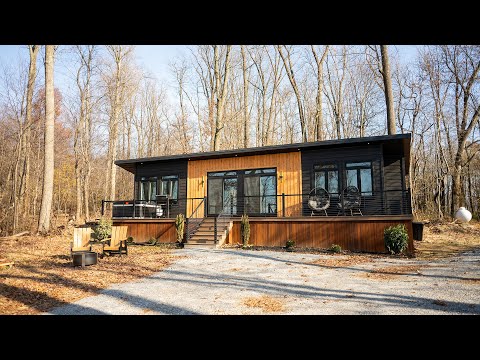
HUD-certified homes and modular homes are both factory-built, but did you know they are not the same thing?
A modular home is built to the state or local building code that applies where it will be permanently installed. In contrast, a HUD home (more commonly called a manufactured home) is built to the federal HUD Manufactured Home Construction and Safety Standards rather than the local residential construction code. West Virginia defines a manufactured home as a structure that is generally at least 8 feet wide or 40 feet long in transport mode, or at least 320 square feet when installed, and is constructed on a permanent chassis.
Modular homes also require a permanent foundation and are immovable while manufactured homes remain on a permanent steel chassis, making them technically mobile.
Zook Cabins offers both types, so one of the first questions we can help you answer is not simply “Which floor plan do you like?” but “Which construction type makes the most sense for your needs?” For further clarification on the differences, head over to our comparison article.
How Close Can a Modular Home Be to Property Lines?
There is no single statewide setback for modular homes in West Virginia. The required distance comes from the zoning or subdivision rules that apply to your specific parcel. If a modular home is being used as a single-family residence, start with the setbacks for a single-family house in that zoning district.
The numbers can change substantially from one property to another. Berkeley County’s residential subdivision standards use 20 feet in front, 10 feet on the sides, and 20 feet in the rear. Putnam County’s R-R District uses 30 feet in front, 10 feet on the sides, and 30 feet in the rear. A standard dwelling in Jefferson County’s Rural District can require 40 feet in front, 15 feet on the sides, and 50 feet in the rear. Even in a county with no general zoning setback, your sewage system must still remain at least 10 feet from the property line. Before choosing the width of your home or foundation location, have the parcel’s actual setback lines confirmed.
Do You Need A Permit For A Modular Home in West Virginia?
Yes, in most parts of West Virginia you should expect to need permits before installing a modular home. Permitting is handled primarily at the county or municipal level, so the exact requirements depend on where your property is located. West Virginia allows counties and municipalities to adopt and enforce the State Building Code, and municipalities may require construction permits for structures within their jurisdiction.
A modular home is treated like a site-built house rather than a HUD-code manufactured home. This means that depending on the property, homeowners may need approval for:
- Zoning permit confirming that a residence can be placed on the lot and meets local setbacks.
- Building permit to cover foundation and site work.
- Electrical, plumbing and HVAC permits for connections and site work.
- Septic or well permits if the property is not connected to public utilities. West Virginia requires local health-department approval for on-site sewage systems before construction in applicable situations.
- Floodplain approval when the property is in a regulated flood area.
- Driveway permits when a new driveway connects to a West Virginia state-maintained road. The WV Division of Highways requires these permits and currently issues residential driveway permits free of charge.
Zook Cabins recommends contacting the county or municipality before ordering your home or beginning site work. Getting answers early can prevent an expensive situation where a home is ready for delivery but the property is not yet approved or prepared for installation.
What Size Modular Homes Does Zook Cabins Have to Offer?

Zook Cabins offers a huge range of sizes, from under 1,000 square feet all the way up to almost 3,000 square feet! For a quick overview of what sizes we offer, check out this table below or visit our lineup of models to see specific sizes.
| Zook Cabins model | Finished size | Bedrooms | Bathrooms |
| The Alpine | 1,144–1,680 sq ft | 2–3 | 1–2 |
| The Chalet | 866–1,901 sq ft | 1–3 | 1–2 |
| The Frontier | 660–1,548 sq ft | 2–3 | 1–2 |
| The Pioneer | 660–1,680 sq ft | 2–3 | 1–2 |
| The Musketeer | 720–1,680 sq ft | 1–3 | 1–2.5 |
| The Sunset Ridge | 1,040–1,680 sq ft | 2–3 | 2 |
| The Two Pines | 935–1,269 sq ft | 2–3 | 2 |
| The Woodland | 738–1,442 sq ft | 2–3 | 1–2 |
What Features are Included in a Modular Home from Zook Cabins?

Each modular home from Zook Cabins comes fully completed with all utility rough-ins and ready for your interior touches. Specific features vary by model, but here is The Lariat, a 768-square-foot, two-bedroom modular home, as an example:
| Feature | What’s Included in The Lariat |
| Living Space | 768 finished sq. ft., 2 bedrooms and 1 bathroom |
| Covered Porch | 6′ × 18′ covered front porch |
| Ceilings | Cathedral ceiling in the kitchen and living room |
| Interior Walls | 1″ × 8″ solid pine wall boards |
| Flooring | Luxury vinyl plank flooring throughout |
| Kitchen | Shaker-style cabinets, countertop, range space, vented hood, dishwasher space and refrigerator space |
| Bathroom | 60″ shower, glass shower door and 48″ custom vanity |
| Storage | Primary bedroom closet, entry closet and large storage area above the bedrooms and bathroom |
| Lighting | Recessed lighting throughout |
| Exterior | 2″ × 10″ tongue-and-groove log siding with 1.25″ chinking |
| Roof | 28-gauge, 40-year textured metal roofing |
| Windows & Doors | 9 operable windows and two 36″ half-glass entry doors |
| Laundry | Space for a 24″–30″ stackable washer and dryer |
| Insulation | R-values designed to meet or exceed applicable local codes |
The Lariat is just one example. Floor plans, porches, finishes, ceiling styles, kitchens, bathrooms and other features vary across Zook Cabins models, giving homeowners the ability to choose a home that fits both their space requirements and preferred style.
Does Zook Cabins Have Modular Homes with Multiple Bedrooms and Bathrooms?
We sure do!
One bedroom, one bathroom definitely doesn’t fit everyone but neither does a huge layout always work for a couple or small family.
Zook Cabins provides sizing options from 470 sq ft all the way up to 2,926 and everything you could imagine in between. The Juniper and The Two Pines models offer spacious two bedroom option while the Spruce and A-Frame Retreat provide that cozy one-bedroom feel.
Need something larger? The Homestead and Canyon Lodge can both go up to 4 bedrooms while the Pioneer and Frontier offer a more middle ground with 2-3 bedrooms.
No matter what you need, our team is confident we can find a new modular home that suits you.
Can A Modular Home from Zook Cabins be Customized?
You need your new space to feel like your very own and we get that.
At Zook Cabins, we care about helping you personalize your living spaces, which is why we provide options for siding and pitch color, add ons like fireplaces and porches for certain models and more exterior choices.
Inside, interested homeowners get to choose from several options for kitchen cabinet style, fixtures, and the layout of their choice.
Call today to learn how you can personalize the model you’re eying!
Do Modular Homes Have Good Resale in West Virginia?
It’s always scary making a huge financial decision like purchasing a new home. The nagging question of, “Will this sell ok in the future?” is often the first thing that comes to mind.
The good news is that modular homes hold a very similar resale value to traditional site-built homes! Fannie Mae doesn’t differentiate and doesn’t require comparable sales like some prefab structures. This means that a well-maintained modular home in a good location on owned land will likely bring the same resale value as a traditional home in the same situation.
According to Redfin, the home resale value in West Virginia is up about 4.2% right now with a median price of $274,142. With that rate, a $250,000 home increasing at a 4.2% compound annual resale value will grow to approximately $377,240 over 10 years, resulting in a total gain of $127,240.
We dive more into this in our modular home resale article which you can peruse for more helpful information.
Or if you prefer to talk to someone about how to finance a modular home, our Financing Manager would be happy to discuss it with you! Call today to talk to an expert on this topic.
Conclusion
That’s it folks, all you need to know about modular homes in West Virginia! Modular homes are a great option if you’re looking for sustainable, affordable housing options, particularly in the WV rural areas where zoning is more flexible.
Zook Cabins would love to help you dwell beyond the ordinary with a beautiful new modular home. If you’re interested in learning more, simply call us today or request a free quote. Let the adventures begin!